C T Online Desk: July 9, 2026- Prime Minister Tarique Rahman today urged the countrymen to transform tree planting and environmental conservation into a daily civic practice, saying the government is working to build a green, climate-resilient and sustainable Bangladesh.
“Tree plantation and environmental conservation should become a part of our everyday lives. If we can make these practices habitual, we will build a healthier and greener society,” he said.
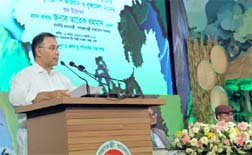
The Prime Minister was addressing the inauguration ceremony of the World Environment Day programme, Environment Fair 2026 and the National Tree Plantation Campaign and Tree Fair 2026 at Bangladesh-China Friendship Conference Center here.
He urged the countrymen to lead the way in creating a truly green Bangladesh as the safety and well-being of humanity are closely tied to the protection and healthy development of the ecosystems.
“We all understand that greening our country is essential for the survival and well-being of future generations. Let us celebrate the birth of every child by planting a tree. May every newborn grow alongside a tree, allowing a nationwide social movement for afforestation to flourish,” he said.
Alongside this social movement, the government has undertaken several institutional initiatives to protect the environment which include introducing Green Volunteerism in educational institutions, launching the Climate Youth Fellowship, and establishing an Environment Start-up Fund, he mentioned.
Tarique Rahman said successful implementation of these initiatives will help build a safe, healthy, and environmentally sustainable Bangladesh for both present and future generations.
He said the government has launched a programme to plant 25 crore tree saplings over the next five years.
“Planting trees indiscriminately is not enough. Scientific assessment is necessary to determine which species are suitable for specific soils, climates, and ecosystems. Species such as eucalyptus and acacia grow rapidly, but further research is needed to determine whether they are truly beneficial for our environment,” he said.
He said priority should be given to indigenous species, including medicinal plants, orchids, bamboo, forest trees, fruit-bearing trees, commercially valuable species, and endangered native plants.
Afforestation alone is not the final goal as forests must also provide safe habitats and adequate food for birds, wildlife, insects, and other living creatures, he said.
He said environmentalists and forestry experts have an important role in ensuring that afforestation strengthens ecosystems. The government’s objective is to maintain an ecological balance where plants, animals, soil, water, and air coexist in harmony, he said.
“Planting new trees is essential, but ensuring that those trees survive and thrive is even more important. Equally important is protecting mature trees that have long been part of our ecosystems rather than cutting them down,” he said.
The Prime Minister said the government has also taken a firm stand against deforestation, hill cutting, mangrove destruction, and wildlife poaching.
“For our own future, we must value our soil, rivers, forests, biodiversity, and natural resources. If we fail to protect our rivers, we cannot ensure agricultural productivity, food or water security,” he said.
He said environmental protection and economic development should not be viewed as competing goals instead development should progress in harmony with nature.
The government also aims to promote rooftop gardening, urban forestry, GIS-based tree plantation, riverside and canal-side greening, and eco-tourism as emerging sectors of the economy, he said.
“Climate change is no longer a future concern—it is our daily reality. Cyclones, floods, droughts, heatwaves, river erosion, and salinity intrusion are threatening agriculture, public health, the economy, and people’s lives,” he said.
In response, Tarique Rahman said, the government views environmental protection not as a separate sector but as a cornerstone of national development.
“Our vision is to establish a green, clean, climate-resilient, and sustainable Bangladesh where economic growth and environmental conservation advance together,” he said.