C T Online Desk: Finance and Planning Minister Amir Khosru Mahmud Chowdhury today said the core philosophy of the upcoming national budget is the democratization of the economy and bringing poor and marginalized communities into the mainstream of economic activities.
“The low-income people have historically been the most deprived in Bangladesh’s budgetary framework. Therefore, we have given priority to the poor, low-income groups and homemakers (housewives) in the upcoming budget,” he said.
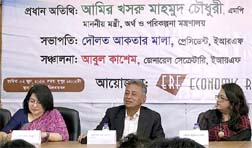
The minister made the remarks while addressing a seminar titled “Budget 2026–27: Expectations and Reality” as the chief guest in the capital today, organised by the Economic Reporters Forum (ERF).
ERF President Daulat Akter Mala chaired the seminar. Executive Director of Centre for Policy Dialogue (CPD) Dr Fahmida Khatun, Chairman of East Coast Group Azam J Chowdhury and President of the Bangladesh Textile Mills Association (BTMA) Shawkat Aziz Russell attended the programme as special guests. ERF General Secretary Abul Kasem moderated the event.
The Finance Minister also said the next national budget seeks to address rising poverty, expand economic opportunities for marginalised groups and reduce bureaucratic obstacles to business, despite being prepared under exceptionally difficult circumstances.
“preparing a national budget within one and a half months of assuming office was almost impossible, noting that the process normally takes at least six months,” he said.
He said the government inherited a fragile economy marked by declining indicators, weak investment, growing unemployment and rising poverty, but was nonetheless required to present a budget within the constitutional timeframe.
“The economy has reached a level where significant intervention is needed to restore stability and put it back on the path to prosperity,” he said, likening the situation to priming a tube well by pouring water into it before groundwater can be drawn.
Responding to criticism over the size of the budget amid economic challenges, Khosru said the government was investing heavily to revive economic activity and rebuild confidence.
He said the budget prioritises low-income and disadvantaged groups who have traditionally been overlooked in national fiscal planning.
Among the key initiatives, he highlighted the expansion of the Family Card programme, under which financial assistance will be transferred directly to women heading households through bank accounts, minimizing opportunities for corruption and political influence.
The minister claimed that a pilot project recorded only a 1-1.5 percent deviation rate and expressed confidence that the programme could achieve near-perfect targeting in future.
He also underscored the government’s focus on farmers through the introduction of Farmer Cards, aimed at strengthening food security and improving rural livelihoods.
On healthcare, Khosru said the government is moving towards universal primary healthcare, noting that Bangladeshis spend a disproportionately high share of their own income on medical treatment.
He said the programme would be implemented through partnerships involving the private sector and non-governmental organisations rather than relying solely on government agencies.
The finance minister also announced significant support for what he termed the “creative economy”, including artisans, weavers, folk craftsmen, performers, theatre artists and other cultural workers.
Under the initiative, targeted groups will receive skills training, access to finance, design assistance, branding support and opportunities to market products online, drawing inspiration from successful international models such as Thailand’s “One Village, One Product” programme.
Khosru said economic growth should not be measured solely through industrial production, arguing that creative industries and cultural activities also contribute significantly to gross domestic product (GDP).
“Our vision is the democratisation of the economy,” he said. “Economic participation and the benefits of growth must reach every citizen and every community.”
The minister reiterated the government’s commitment to strengthening the private sector, describing it as the primary driver of economic growth while positioning the state as a facilitator rather than a regulator.
He announced plans to simplify regulatory procedures through a one-stop service system under which multiple approvals would be processed within specified timeframes.
Applications not acted upon within the prescribed period would be deemed approved, he said.
Calling for a “deregulated economy”, Khosru said excessive controls had constrained businesses, citizens and institutions for years.
On budget implementation, he acknowledged concerns over low execution rates and said the government would introduce digital monitoring systems across the ministries.
According to the minister, all development projects will be tracked through dashboards at the ministry, finance ministry and Prime Minister’s Office levels, allowing delays and bottlenecks to be identified in real time.
He said future project selection would be guided by four criteria: value for money, return on investment, job creation and environmental sustainability.
The government has already reviewed around 1,300 ongoing projects inherited from previous administrations and plans to cancel those that fail to meet the new standards while repurposing others to improve economic returns, he added.