C T Online Desk: May 21, 2026- As the holy Eid-ul-Azha approaches, sacrificial animals are being transported in trucks to Chattogram. There is an ample supply of sacrificial animals in Chattogram city and its surrounding areas this year, as confirmed by officials.
In addition to Greater Chattogram, cows, goats, and buffaloes have started arriving from various districts, including the hill districts and Cox’s Bazar, to the animal markets in Chattogram city and upazilas.
The District Livestock Department estimates the demand for sacrificial animals in Chattogram this year to be 818,681, while local farmers have 783,151 animals available. With the supply of animals from local farmers and households, as well as those coming from different districts, there is no risk of a shortage of sacrificial animals in Chattogram. In fact, there may even be a surplus of some animals.
The District Livestock Officer, Dr. Mohammad Alamgir, mentioned that there is a slight shortage of sacrificial animals in Chattogram, but this will be addressed by cows brought in by traders from various regions such as Rajshahi, Naogaon, Bogra, Sirajganj, Dinajpur, and Kushtia. Additionally, there is an excess of sacrificial animals in districts like Khagrachari, Rangamati, and Bandarban, which are also being brought to the Chattogram market. Local farmers and households are also contributing to the supply of sacrificial animals with cows and goats raised in the area.
Dr. Alamgir noted that cows and goats are being raised in various farms, including on roads and alleys, to meet the demand. Trucks from different parts of the country are transporting animals to fulfill the local demand, with some animals expected to exceed the requirements. Chattogram District Livestock Office estimates the demand for sacrificial animals in the district to be 818,681, while the current stock from local farmers stands at 783,151, resulting in a shortfall of 35,530 animals. Data from the Livestock Department shows that production was 852,359 in 2024 and 842,165 in 2023.
Production this year has decreased to 783,000 animals, with locally raised animals including 374,999 bulls, 90,488 oxen, 33,792 cows, 47,834 buffaloes, 194,519 goats, 41,423 sheep, and 96 other animals.
While there is a surplus of animals in rural areas and upazilas of Chattogram, urban areas face a deficit. Upazilas like Mirsarai, Sandwip, Sitakunda, Fatikchhari, and Lohagara have significant numbers of animals, while areas like Panchlaish, Kotwali, and Double Mooring face shortages. Dr. Md. Alamgir, the District Animal Resources Officer, mentioned that surplus animals from rural areas are being supplied to the city.
Currently, there is a surplus of over 22 lakh sacrificial animals in the country, ensuring that the demand for sacrificial animals can be met without traders exploiting the situation. Farmers in the Karnaphuli area are facing challenges due to increased costs of cow feed, medicines, and labor wages. This has led to a decline in production, with some farmers even closing their farms. Despite these challenges, sacrificial animal markets are gearing up in Chattogram ahead of Eid-ul-Azha.
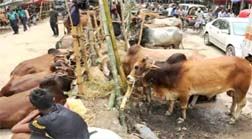
Traders from various parts of the country are bringing cows, goats, buffaloes, and other sacrificial animals to the market. The City Corporation has both permanent and temporary animal markets where these animals are bought and sold. Additionally, cattle trading also takes place in the alleys and farms of the city. However, sellers have noted that initial sales are slow. Despite a good supply of animals in the market, there are fewer buyers than anticipated.
One trader, Md. Mohsin, brought 140 cows from Daulatpur in Kushtia to Chattogram. They plan to sell these cows in different markets within the city. However, they have not made any sales yet and hope to start selling from Friday. Another seller, Jalil Ahmed, mentioned that costs for food, transportation, and labor have increased, leading to slightly higher cattle prices. They are seeking a fair price and cannot afford to sell at a loss.
Buyers like Shamim Hossain have noticed the increase in cattle prices compared to last year. They are exploring different markets to find the best deal within their budget. In addition to the official cattle market, cows are also being sold in various areas of the city, including Gate No. 2, Bahaddarhat, and Oxygen.
Farmers like Abu Taher in Chandanaish have prepared extensively for the Eid market, with a sufficient supply of domestic cattle available. Both traders and farmers believe that the current prices are fair, despite some buyers feeling they are high. They anticipate the market to pick up in the coming days.